Every golfer knows this feeling. You show up to the course with your friends, someone suggests playing a team game, and everyone nods along pretending they understand the rules. Two minutes later you are all standing on the first tee more confused than when you started. Is Best Ball the one where everyone hits? If I card a 6 but my partner cards a 4, do we win the hole? Are Scramble and Best Ball the same thing?
Nobody wants to play with that guy. We broke down every format so you never have to be clueless on the first tee again.
Scramble, Best Ball, and Alternate Shot are three of the most popular team formats in recreational golf and they each create a completely different round. The format you choose changes the pressure, the strategy, the pace, and the whole vibe of the day. Here is everything you need to know about each one, when to use them, and how to pick the right format for your group.
The Short Version If You Are In a Hurry
Here is everything you need to know about Scramble, Best Ball, and Alternate Shot, side by side. How each one works, who it is for, and what kind of round it creates.
| Format | How It Works | Best For | Pressure | Individual Scores | Counts Toward Handicap |
|---|---|---|---|---|---|
| Scramble | Everyone hits, team picks the best shot | Outings, mixed skill groups, beginners | Low | ✕ No | ✕ No |
| Best Ball | Everyone plays their own ball, lowest score counts | Competitive groups, money games | Medium | ✓ Yes | ✓ Yes |
| Alternate Shot | Partners share one ball, alternate every shot | Ryder Cup-style matches, strategic partners | High | ✕ No | ✕ No |
What Is a Scramble?
If you have ever played in a charity golf tournament or a corporate outing, you have almost certainly played a Scramble without knowing it had a name. Everyone hits, the team picks the best shot, and you all play from there until the ball is in the hole. One team score, no individual totals, and no single bad shot can blow up a hole.
What makes Scramble the most popular format in team golf is that it allows everyone to contribute. A high handicapper can be the most valuable person on the team on any given hole if they drain a long putt or give their team a great read of what not to do. The format removes the ceiling on how bad a hole can get and replaces it with a shared celebration every time anyone on the team does something good.
For a full breakdown of how Scramble works in 18Birdies, head to our Scramble Mode breakdown here.
Where Scramble falls short is accountability. Because bad shots disappear entirely, individual performance becomes impossible to measure and the result does not reflect what any one player actually did that day. If your group wants everyone on the hook for their own game, Best Ball is the better format.
Charity tournaments, corporate outings, bachelor and bachelorette trips, groups with mixed skill levels, any round where the social experience matters as much as the score.
What Is Best Ball?
Best Ball is where the "wait, so if I make a 6 and he makes a 4, do we win the hole?" confusion usually comes from. Simple answer: everyone plays their own ball the entire hole, and when everyone holes out the lowest score on the team goes on the card. Your 6 did not hurt anyone. It just did not help.
That is what makes Best Ball the go-to format for competitive groups. Your round still belongs to you. Your birdie on 12 is yours, and when it is the best score on the hole it carries the whole team. There is also a sense of pride in Best Ball that no other format replicates. After the round you can look back and see exactly how many holes you won for the team (and how much your friend was slacking).
Because everyone plays their own ball, Best Ball is also the only team format that counts toward your handicap index. Scramble and Alternate Shot do not generate individual scores so they will not post. If keeping your handicap accurate matters to your group, Best Ball is the way to go.
You have seen this format at the highest level. The AT&T Pebble Beach Pro-Am pairs PGA Tour pros with amateur partners in a Best Ball format, which is exactly why the event works. One player can carry the team on any given hole regardless of what the other does. The Ryder Cup also uses it under the name Four-Ball during the pairs sessions.
In 18Birdies, handicap strokes are automatically calculated so you can see exactly where each player is getting their strokes and how the net scores shake out without anyone doing any of that annoying math on the green.
Competitive friend groups, side bet matches, money games, rounds where individual performance matters, players who want their handicap tracked, Ryder Cup-style team matches.
What Is Alternate Shot?
Alternate Shot is the one that sounds simple until you are actually playing it. Two players, one ball, every shot alternated between the two of you until the hole is finished. Your partner tees off on the odd holes, you tee off on the even holes, and whoever did not hit the last shot hits the next one regardless of where it ended up.
That last part is the thing that gets people. If your partner drives it into a fairway bunker, you are hitting out of the fairway bunker. If you leave a 40-footer on the last hole with the match on the line, your partner is putting it. There is no escaping what the other person did. The format forces you to think about every shot not just in terms of your own game, but in terms of what you are leaving your partner to deal with.
That pressure is exactly why Alternate Shot is the most mentally demanding format in recreational golf, and also why it is the most satisfying when a partnership clicks. Nobody illustrates this better than Rory McIlroy and Tommy Fleetwood, who have built one of the most dominant foursomes partnerships in Ryder Cup history. Foursomes is the Ryder Cup name for Alternate Shot, and McIlroy summed it up perfectly after their 2025 win at Bethpage: when you have a partner you trust, you play with complete freedom because you know someone has your back. That is Alternate Shot at its best. When the chemistry is off, it is one of the most frustrating formats in golf.
The format also moves fast. Two players sharing one ball means fewer shots, less time spread across the fairway, and a round that can be wrapped up in well under two hours if the pace is good.
It rewards partners who think alike, communicate well, and can handle pressure without rattling each other. It is not the format for every group or every day, but when the chemistry is right it produces some of the most memorable rounds in golf.
Two-player competitive matches, Ryder Cup-style events, partners who know each other's games well, fast rounds, golfers who want strategy and pressure baked into every shot.
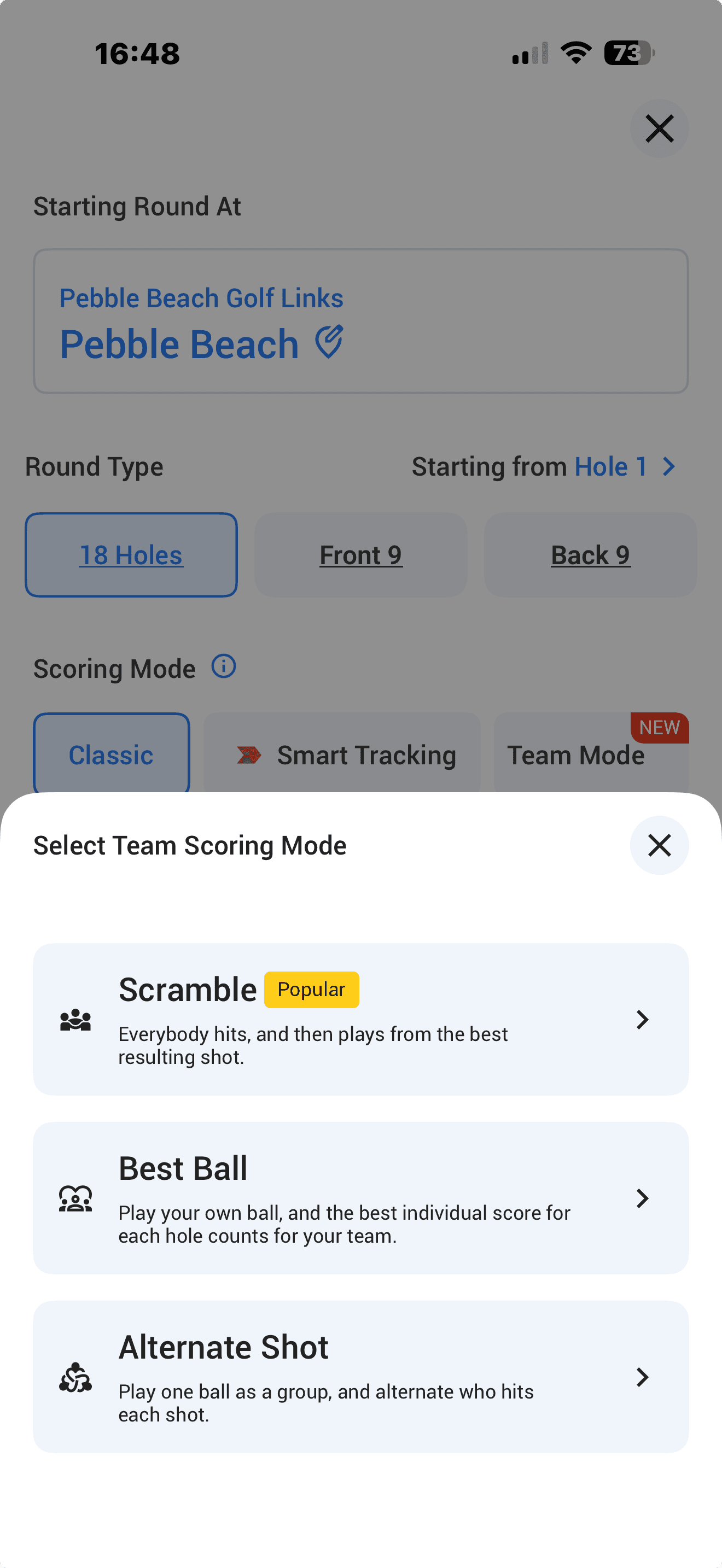
All three formats. One tap to set up.
Pick your format, set your teams, and let 18Birdies handle the scoring while you focus on playing.
Which Golf Format Is Right for Your Group?
The right format depends on who you are playing with and what you want out of the round. Here is the quick decision guide for the most common groups in the United States.
Scramble. It works across all skill levels, keeps everyone involved, and moves at a pace that fits large groups.
Best Ball. Everyone plays their own ball, every score matters, and the format rewards consistency across 18 holes.
Depends on the group. If skill levels are mixed, start with Scramble to keep everyone loose and having fun. If the group is competitive, Best Ball keeps individual stakes alive across the round. If you are playing multiple days, try a different format each day. Scramble on day one, Best Ball on day two, and Alternate Shot on the last day when everyone is comfortable enough with each other to share a ball and find out who actually holds up under pressure.
Scramble every time. The format protects weaker players, removes the pressure of a bad hole, and gives everyone a shot that matters.
Spread the formats across the trip. The Ryder Cup uses three formats across three days, and the same idea works for a buddies trip. Open with Best Ball when everyone is fresh and competitive. Roll into Alternate Shot for the strategic, partner-driven round. Close with singles match play on the final day to crown a winner. One format per day keeps every round feeling new without burning out the group.
Best Ball. It is the only team format where every player plays their own ball and records their own score, meaning rounds can count toward your handicap index. Set it up in 18Birdies and handicap strokes are calculated automatically.
Running a Larger Event or Tournament?
If you are organizing something bigger than a single group, the Tournaments and Leagues feature in 18Birdies supports Best Ball, Scramble, Stroke Play, and Stableford across larger fields. Playing the same type of golf with the same partner every week gets old fast. Mix up the groups, try a new format, and let 18Birdies handle the scoring while you focus on playing.
Set Up a TournamentHow to Play All Three Formats in 18Birdies
Now that you know which format fits your group, start a new round in 18Birdies, select Team Scoring, choose your format, set up your teams, and go. For Best Ball the app automatically calculates the team's best score per hole so nobody has to do math on the green. For Scramble and Alternate Shot one score gets entered per team after each hole. After the round the result posts to the Community Feed where everyone can see the full scorecard and share it.
Pick a format. Grab your group. Go play.
The best round of the year usually starts with someone finally saying let's just play. Set up your team round in 18Birdies and the scoring takes care of itself.
Play Team Mode